

Why spec mistakes are expensive
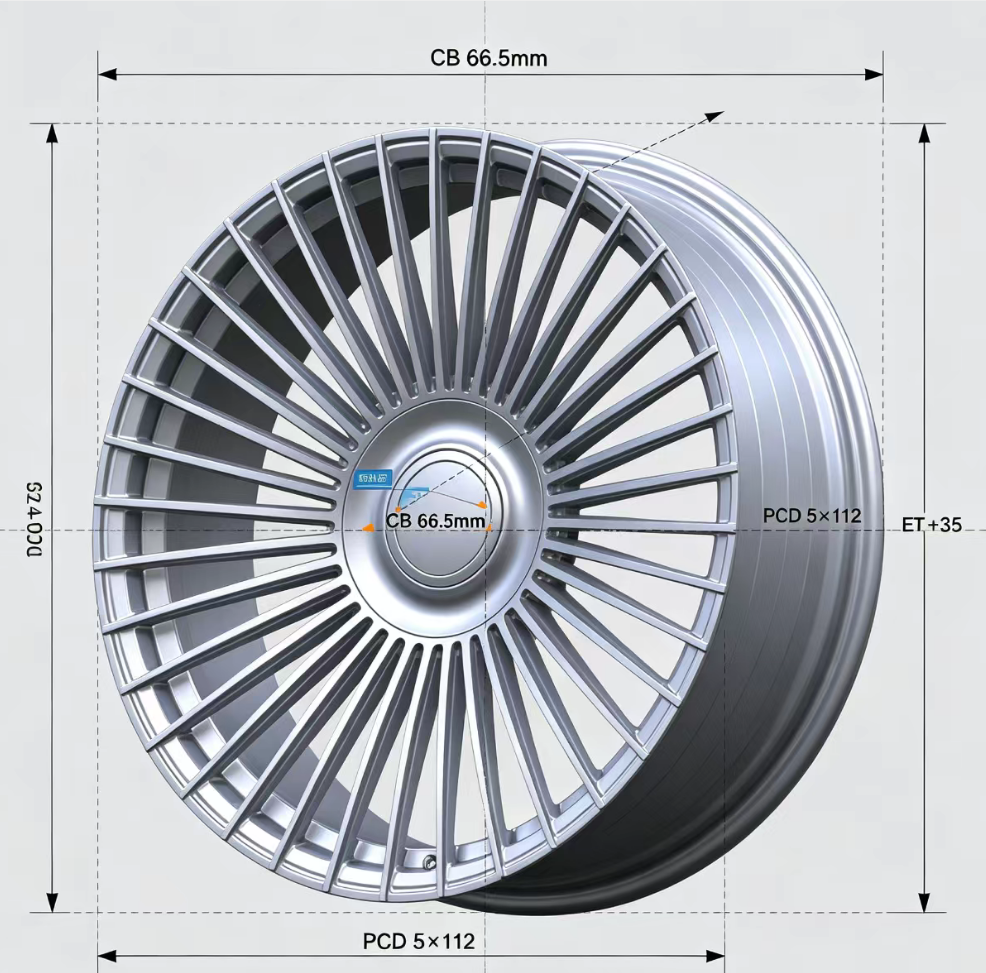
Roughly half of the fitment questions we receive come down to the same three numbers: PCD, ET and CB. Get one wrong and the wheel either won’t bolt on at all, or it bolts on and rubs the fender the moment you load the car. This guide explains what each number means, where to find it, and the mistakes that cost buyers the most money.
1. PCD — Pitch Circle Diameter (the bolt pattern)
PCD tells you how many bolts the wheel has and how far apart they sit. It is written as 5×112 — five bolts, on a 112 mm diameter circle.
– 5×112 is the standard bolt pattern for most modern Mercedes passenger cars (C-Class W205, E-Class W213, most GLC/GLE).
– 5×130 appears on G-Class W463, Sprinter and several heavier models.
– You cannot change a car’s PCD. If your car is 5×112, you need a 5×112 wheel. Adapters exist, but they add thickness and change offset — most professional buyers avoid them for road use.
Buying tip: a dual-PCD wheel (e.g. 5×112-130) reduces your SKU count, because one wheel covers both patterns with two sets of bolt holes. It is common in replica ranges for exactly this reason.
2. ET — Offset (Einpresstiefe)
ET is the distance, in millimeters, between the wheel’s center line and its mounting face.
– Higher ET (e.g. ET45) → the wheel sits further inward, closer to the suspension.
– Lower ET (e.g. ET30) → the wheel sits further outward, closer to the fender.
– ET0 → mounting face is exactly on the center line.
Going too low pushes the tire into the fender arch (rubbing on compression). Going too high can cause contact with the brake caliper or inner suspension. A change of ±5 mm is usually tolerable; ±10 mm or more changes steering feel, scrub radius and wear.
3. CB — Center Bore
CB is the diameter of the hole in the middle of the wheel, measured in mm. It must match the hub.
– CB smaller than the hub → the wheel physically will not seat. Never force it.
– CB larger than the hub → it fits, but requires hub-centric rings to keep the wheel centered, otherwise you get vibration at speed.
– CB equal to the hub → ideal, no rings needed.
Mercedes passenger hubs commonly sit around 66.45–66.6 mm — which is why you see those values in wheel listings.
4. Width and diameter (the numbers before the pattern)
A spec line like 21×9.0 means a 21 inch diameter, 9.0 inch wide wheel. When front and rear differ — 21×9.0 front / 21×10 rear — that is a staggered fitment, common on rear-drive and performance cars to put more rubber on the driven axle.
5. The spec line decoded
Here is a real listing read end to end:
21×9.0 | 5×112-130 | ET 30-34 | CB 66.45-66.6
Part Meaning
21×9.0 21 inch diameter, 9.0 inch width
5×112-130 5 bolts, dual PCD 112 mm and 130 mm
ET 30-34 offset range 30–34 mm
CB 66.45-66.6 center bore range, hub-centric fit
6. Four mistakes buyers make most often
1. Measuring PCD by hand with a tape measure. On a 5-bolt wheel you must measure from one bolt center to the circle, not to the opposite bolt. Use the manufacturer spec instead.
2. Ignoring offset when upsizing diameter. A bigger wheel with the wrong ET rubs, even if the PCD is correct.
3. Skipping hub-centric rings on a larger CB. Cheap fix, big vibration problem if forgotten.
4. Trusting the listing title instead of the spec table. Titles are marketing; the spec table is what ships.
7. Load rating is not optional
For SUVs, vans and any loaded vehicle, check the load rating per wheel against your axle weight. Ask your supplier for the test report — JWL, VIA or TÜV documentation should be available on request. A supplier who cannot produce it is telling you something.
Get the full fitment guide
We publish a Mercedes wheel fitment guide covering PCD, ET and CB ranges by model year, including staggered setups. Request the PDF using the form below, or send us your VIN and current wheel specs and our team will confirm fitment before you order.
→ Download the Fitment Guide (PDF)
→ Ask a fitment question